Passing time in my wife´s hometown of Coronado, Costa Rica has enabled me to enjoy the fruits of their wonderful farmer´s market. Every Sunday, agricultural producers from around the region reunite to promote their agricultural products to a hungry public. Two years ago a study revealed that Costa Rica is home to some of the healthiest, happiest people in the world. With the quality of fresh fruit and vegetables available at the farmer´s markets around the country it is easy to see why. Rather than buying canned or frozen vegetables most people their fruits and vegetables direct from a local producer. Meals here are typically accompanied by refreshing fruit drink called refresco. The Feria provides a wide variety of fruits ideal for these refreshing drinks. To the new visitor to the tropics the array of new fruits, vegetables, cooked and raw can be dizzying. The friendly sellers are always eager to answer questions and vocally encourage buyers proclaiming the quality of their products. Know Your Roots!!! Here you can see four different subterranean starchy root crops that are produced here. Standing out prominently are the purple skinned sweet pòtatoes (camotes) Ipomoea batatas seen throughout the country. In the left are two different types of Taro Colocasia esculenta seen here in Costa Rica. One, Ñampe, has a predominantly white flesh while the other, Tiquisque, is sprinkled a red or pink color. These edible corms have large elephant ear-like leaves and are members of the Araceae family. Finally, the roots on the right are Cassava (Yuca), Manihot esculenta. Eaten commonly throughout Costa Rica is this curious and versatile member of the Cucurbitaceae family, the Vegetable Pear (Chayote) Sechium edule. Baby chayotes like the ones shown in this picture can be steamed and eaten in their entirety. Larger chayotes range in color from deep to light green to white and are used in a variety of Costa Rican dishes. Also in this photo is the Chayote root, Raiz de chayote, which is highly prized and cooked as a vegetable. Chayote the only cucurbit I know of that you actually plant the entire squash as the plant sprouts out of the fruit´s one central seed. Less commonly seen in the markets but also enjoyed are Tacacos, Sechium tacaco a smaller, spikier wild relative of the chayote.
Costa Rica is most commonly known for tropical fruits but the high elevation colder regions of the country produce a wide variety of temperate fruit crops. Here, local producers show off their crops of apples, plums, and blackberries. Get to know a Costa Rican person and if you´re lucky they will invite you over in the afternoon for a cup of coffee and boiled pejibayes, peach palm, Bactris gasipaes, nearly always served with a dollop of mayonnaise. These nutritious fruits grow on a palm tree covered with long spines. Pejibaye trees can also be managed for production of heart of palm or palmito. Mangos Mangos Everywhere! Mango season seems to be lasting forever this year in Costa Rica. These mangos are of the large variety grown usually on grafted tres and known as Mangas here in Costa Rica. Its a great time to juice them freeze them, etc as they were selling 4 kilograms for 1,000 colones ($2!!!!)
As a sign of appreciation to my good friends Noah and Alex who have been helping me maintain the farm I decided to take them to see a very knowledgeable tropical fruit grower named Mario Mendez. Mario is an expert grafter and singlehandedly maintains 8 hectares of tropical fruit plus a large nursery. He focuses on Rambutan or Mamon Chino and Avocado but maintains collections of several rare fruits as well. As I drove the coastal highway from Uvita to the sleepy town of San Buenaventura where Mario´s farm is located I recalled my first meeting with Mario nearly three years ago.
It was a hot and humid August day when I headed down to Ciudad Cortez with a couple of friends to visit a property one of them had purchased. As we drove through Cortez smiling faces greeted us at every corner and showing us their bags of Mamon Chinos they had for sale. These beautiful bright red fruits were everywhere and we quickly began gobbling them up. The Rambutan (Nephelium lappaceum) is a member of the Sapindaceae family which includes other delicious fruits like the Lychee (Litchi chinensis) and the Pulasan (Nephelium mutabile) . Its translucent flesh is sweet and juicy and grape like in consistency. We were hooked immediately and it occurred to me that I had not yet planted Mamon Chino at Finca Carolina. So I began asking the Mamon Chino sellers where I could buy some good Mamon trees. Quickly, I was informed that in the town of San Buenaventura lived a man named Mario with lots and lots of Mamon Chino trees. So it was off to San Buenaventura where more Mamon sellers excitedly pointed us in the right direction to find Mario. We did eventually find Mario and sampled his delectable fruits and headed back to Uvita with several Rambutan trees to plant at the farm.We were impressed by his orchards and vast knowledge of tropical fruit production
Mamon Chinos do not yield in Southwest Costa Rica until August so there were no Mamons on this visit but Mario always has a few surprises for the tropical fruit lover. First he let us sample guava fruit from his Brazilian guava tree (Psidium guavaja, Family Myrtaceae). Its bright pink flesh was oh so inviting and delicious. Guava fruits are high in antioxidants, Vitamin A and C, folic acid, and many minerals.
Next, Mario proudly showed us his Borrojo tree in fruit. Borrojo (Borojoa patinoi, Family Rubiaceae), head fruit or fruta cabezona is native to Western Panama and is cultivated on small scale in Panama and Southwestern Costa Rica. Mario says that just a small piece of this fruit is enough to flavor an entire pitcher of refresco or refreshing fruit beverage. Borrojo is rumored to have aphrodisiac powers and is used in folk medicine to treat impotency. You heard it here first! The plant family Rubiaceae has yielded such important plants as coffee (Coffea arabica, Coffea canephora) and the source of the anti-malaria medicine Quinine (Cinchona pubescens).Many of the understorey shrubs that one encounters in the rainforests of Southwest Costa Rica belong to the Rubiaceae family.
Finally, Mario showed off his large crop of Acerolas or Barbado Cherries. This small, delicious cherry like fruit is packed with Vitamin C. Acerola is being added to a variety of juices in order to boost their Vitmain C content. One of the small fruits is supposed to contain the Vitamin C of four oranjes. This sprawling shrub is a great choice for the home grower in Southwest Costa Rica as it is hardy and fruits prolifically. Acerola, (Malpigia emarginata), is a member of the Malpighiaceae family which contains other plants of ethnobotanical interest like the nance, (Byrsonima crassifolia) a small yellow fruit enjoyed throughout Costa Rica and beyond and Banisteriopisis caapi which is used in the preparation of the South American visionary beverage ayahuasca or yaje.
During the past week I had the pleasure of building an adobe oven with a group of eager Permaculture students. We built the oven as part of the Practicum portion of the Permaculture Design Course that we just hosted. I highly recommend to anyone interested in building their own adobe oven to pick up Kiko Denzer's book called Build Your Own Earthen Oven (Hand Print Press, 2007). This book guided another group of friends and volunteers and I to construct an oven in 2004 at Finca Carolina. Anyone familiar with Finca Carolina has probably tasted the delicious pizzas that come out of that adobe oven. Based on years of experience with our own adobe oven I realized two design improvements that would improve functionality and flow of the oven. One was to have a grill in close proximity to the oven where I can put the hot coals after removing them from the oven. Secondly, I realized that a reinforced doorway is needed in order to prevent damage to the clay from placing and removing the door. We were lucky enough to have an existing outdoor kitchen with a grill and a concrete floor large enough to house this large oven. A local builder helped us to first construct a cinder block box. The box was filled with rocks, concrete debris,gravel and then finally sand. On top of that sat a floor of refractory bricks onto which we marked a 36" circle. This would be the eventual diameter of the oven. We then made a dome of wet sand and covered it with wet newspaper. Upon that we began to add our various layers of mud. The first layer was a 5" of a clay and sand mixture. See Kiko's book for details about determining correct proportions. This was followed by an insulating layer the same thickness and components but with straw. Finally, the whole oven and cinder block box was plastered with an earthen plaster. After about two weeks the oven will be ready to begin burning small fires inside. Once the oven is dry and hard it will be ready for pizza and bread baking.
This is an article I recently wrote for Ballena Tales.
What is Permaculture?
Permaculture is a term coined by an Australian farmer and scientist named Bill Mollison in the 1970’s and means permanence in agriculture and culture. Permaculture is a philosophy aimed at designing self-sustaining human farms, settlements, and communities. Permaculture farms share many features with organic farms as they are free of chemical pesticides and fertilizers. Permaculture differs from organic farming in that a Permaculture farm tries to generate all resources needed directly on site. Both organic farming and Permaculture contrast sharply with modern conventional agriculture which depletes natural resources, pollutes our environment, and produces unhealthy food.
Permaculture is a system of design based on patterns and cycles observed in Nature. In Permaculture designers aim to arrange the elements within a farm or settlement in a way that is logical, energy-efficient, and harmonious with nature. If you would like to become a certified Permaculture designer, you can do so this February and March right here in Costa Ballena. UTSI, the Uvita Tropical Studies Institute, will host a two week Permaculture Design Course and one week Practicum with legendary Permaculture instructor Scott Pittman from February 19th to March at 5th at Finca Carolina on La Union de Uvita. For more information please visit http://www.permaculture.org/nm/index.php/site/chain/ or email Andrew@utsi.org.
2010 has been an exciting and very busy year at Finca Carolina. We enjoyed our first harvest of Canistel fruits this year (Pouteria campechiana). This delicious fruit is also known as egg fruit as it has the consistency of the yolk of a hard boiled egg. However, the flavor is sweet and a bit flowery and evokes a bubble gum like flavor. It is delicious eaten out of hand or can be made into a smoothies with milk or baked into delicious pies and desserts.
We made great progress this year on identifying the plants found around the farm and forest. Marcia Gomez, a forestry student at the Institute of Technology has been a huge help in identification of forest herbaceous plants and trees. There is lots more work to do and we welcome any assistance on this large project. The eventual goal is an interactive list and map of the farm. The list will describe the plants and all of their potential value to humans as food, medicine, fiber, building material, or ornamental value. In addition to providing an online source of information visitors to Finca Carolina will be able to discover these plants for themselves as they hike our extensive hiking trails. The plant list can be found on UTSI's group on Facebook.
Our day tours continue to grow in popularity as guests walk away from them highly satisfied and inspired by the intense Nature they have experienced at Finca Carolina. The howler monkey shown in this photo and the sloth were both seen during day tours at Finca Carolina.
We are very excited to announce that we will be hosting a Permaculture Design course at Finca Carolina next February and March. Scott Pittman, a legendary Permaculture teacher who taught for many years alongside of Permaculture founder Bill Mollison will be instructing the course. The course lasts two weeks and is followed by a one week hands-on practicum. During the practicum we will be constructing a composting toilet, digging new raised beds, preparing compost and caring for our large garden and orchards. Groups we plan to host in the future include African Drumming and Dance, and Tropical Plant Taxonomy. If you would like to lead a course at Finca Carolina please contact me.
Finally, we are now much easier to find. We have put up a sign along the Coastal Highway in Uvita. Now when you come to Uvita, just keep heading south until you see the Finca Carolina sign and take a left. Go up three kilometers and you can't miss us on the left side. We hosted a great deal of volunteers throughout the year and thank all of you for all of your hard work and positive attitudes.
It's rainy season here in Costa Rica. This rainy season has been a bit drier than I am used to. We are greeted nearly every morning with blue skies and warm temperatures. By mid to late afternoon, the rain usually starts up. Sometimes it may only last an hour or two or sometimes it may go all night. Conditions are optimal for plant growth: plenty of sunlight and water. I took a morning stroll around the farm and captured some pictures of the showy flowering plants around Finca Carolina. Many Heliconia species are in bloom now which bring a diverse array of hummingbirds to sip their nectar. The bright red flower (Etlingera elatior) shown at right is a member of the Zingiberaceae family and employs showy red bracts to attract pollinators. Known also as torch Ginger or Emperor's Staff, this plant grows vigorously and makes a colorful addition to a tropical landscape. I had the good fortune of acquiring some cuttings of a variegated Yuca plant (photos below). Yuca, or Manihot esculenta (Cassava) is a staple starch crop throughout the New World Tropics. This variety also makes an edible root in addition to the vibrant leaves. Yuca is one of those great tropical plants that you can literally plant a branch in the ground and it will grow.
Manihot esculenta
Another plant of interest that is fruiting right now is chocolate. Chocolate? Well, chocolate doesn't exactly grow on trees but cacao seeds do which must be dried, roasted and ground before being processed into cocoa butter from which the chocolate we eat is made. The cacao seeds are rich in antioxidants and a variety of alkaloids all of which contribute to the feeling of well being one experiences after eating some good chocolate. The seeds themselves are quite bitter so lots of sugar must be added to arrive at a chocolate resembling what we eat. Theobroma cacao was domesticated by Central American Pre-Colombian Indians and a chocolate beverage made from the ground seeds is still enjoyed by indigenous people throughout the region. In addition, the football shaped capsules showed in photos below contain a rich, white, edible, sweet pulp surrounding the seeds.
Theobroma cacao
The White nosed Coati or Pizote (Nasua narica) is a raccoon like animal found from Arizona south to Colombia and Argentina. They are omnivores who spend their days foraging for fruits, insects, and small invertebrates. The individual seen in this picture has been visiting the edges of the garden for weeks now. He scratches the ground for eaarthworms and agilely climbs and descends trees. The tree he is climbing is a Cecropia (Cecropia spp) or Guarumo, a pioneer species tree that produces great quantities of a legume-like fruit(botanically an achene), attract a wide range of creatures. At Finca Carolina this includes striking birds like the Firey-billed Aracari (Pteroglossus frantzii) or Cusinga and the Chestnut-mandibled Toucan (Ramphastos swainsonii). Only the older Pizotes live solitary lifestyles so he is likely an adult male. Younger males, females, and offspring live in bands of 5-25 members. At Finca Carolina, I have encountered such groups and they typically flee quickly from human presence. This individual, however, is remarkably unafraid of us. The Pizote is just one of the many species of animal life that UTSI is trying to protect with our Nature Reserve. All photos were taken at Finca Carolina de Uvita, in Uvita, Costa Rica.
To understand how Finca Carolina came to be what it is today one needs to back up in time, how long? (I must be getting older) let’s say about 14 years. Approximately 1994-1999 at The University of North Carolina at Chapel Hill. I studied Anthropology and Environmental Studies and graduated in 1998. However, for me and many other friends with whom I am still close will say that it was the friendships that we made that we value the most today. Lifelong alliances formed for many of us during this period. This was a period of questioning all elements of what we called the establishment or The Machine. Many of the downfalls of industrialized society were becoming more and more apparent each day. Ideas and information from classes about environmental degradation worldwide, unjust foreign policy, the failure of the War on Drugs inspired lengthy conversations that often lasted all night often fueled by red wine and brownies. As we looked at what our modern world had to offer: work like hell for somebody else for somebody else until you’re 65 years old, get your retirement, and head to sunny Florida; we simply were not inspired to follow this route. I personally felt then and feel to this day that we as the human race are capable of much more. One of the highlights of our group of friends was that we possessed a tremendous range of talents including great artists, musicians, writers, and teachers.Incredibly enough, during the years following this era this list has grown to include a number of UNC-Chapel Hill degree carrying farmers, carpenters, furniture builders, and a blacksmith.Dreams of community and working together cooperatively entered the discussions on many nights. For some, those dreams faded after graduation while for others like myself they just wouldn’t go away. I turned to agriculture, particularly organic agriculture as a way to reconnect myself to some of the basic cycles of Nature.
During the course of my undergraduate experience I had an opportunity for which I have always been and will always be grateful: A study abroad semester in Belize. Unlike most Study Abroad students heading off to places like France, England, Spain, etc, I decided to enroll in a program focused on natural and cultural ecology in Belize. I immediately fell in love with the tropics: the fruits were so inviting and delicious and there was always a new fruit waiting to reveal itself to me. In Belize, I met so many wonderful people who were hardworking, resourceful, and ready to share whatever they may have to offer. I also begin to learn about the dynamics between the North and the South, or developed versus developing nations. I traveled to banana plantations where toxic chemicals were endangering the health of workers and entire ecosystems. I saw also in Guatemala indigenous farmers forced to farm marginal, incredibly steep mountainsides while lush agricultural valleys were planted with pineapples and coffee for export. I met so many people who despite tough economic conditions seemed happier overall than many North Americans who had literally all they could possibly need and more at their fingertips.As I looked at the hands of the Belizean people, young and old, and then looked at my own, the hands said it all. My hands were soft, not a callus on them, for they had held little more than books and pens at this time. The hands of the Belizean men and women and women told a different story of hard physical work with their long since hardened calluses. I became inspired to want to learn to work with my hands, to do things that my own education had simply not included. An early mentor for me, Emmeth Young, in the Belizean village of Gales Point Manatee taught me how to build African drums and began my instruction in playing them. I continue to build and play African drums to this day. I also started to learn to use a machete and learned to recognize many of the tropical crops I would later grow at Finca Carolina.
Return trips to Central America brought me to Costa Rica, Honduras, and Nicaragua continued to fuel and feed my passion for the tropics.It was Costa Rica, however, that captivated me the most and found myself imagining a life for myself there. Robert, one of my closest allies, entered a sustainable agriculture program of study at Central Carolina Community College and two years later was managing a small organic vegetable farm called Green Toe Ground (The pristine Toe river borders the farm) in the mountains of North Carolina in a gorgeous valley called Celo. He was four years into running the farm when I showed up for what was to be a brief visit but turned into a farm internship that lasted two growing seasons. My experience with farming at that point had been some volunteering at Sustenance Farm, near Pittsboro NC; and I had completed a Permaculture design course in New Mexico under the tutelage of Scott Pittman.At Green Toe Ground I learned the ins and outs of running a small organic farm. Cover cropping, composting, crop rotations, natural soil amendments, nutrient management, companion planting, and green manuring were among the concepts and practices I learned at green Toe Ground. Robert had also been to Costa Rica on numerous occasions and we continued to dream about buying land there to start a self sustaining farm, ecological education center, and ecotouristic business endeavor.When we decided to make a land scouting trip down here in the winter of 2002, our third partner, Dave, who had also traveled to Costa Rica, let us know that if we found some great land that we was in too! Through different means and travels we had all experienced Costa Rica and Pura Vida and had all been captured by it. We were hooked.
We were three guys with a dream: to create a paradise like garden with an existence directly intertwined with Nature. To go to sleep each night listening to a myriad of insects, frogs, owls, night birds, and many others. To awaken early in the morning to sounds of troops of howler monkeys informing their whereabouts to neighboring troops or perhaps a noisy flock of screeching, iridescent, green parrots. To create a space in which all art forms thrive and individuals create and achieve great things because they are doing each day what they truly love to do. To work together towards common goals.To cultivate healthy food on healthy soils. To learn from the local people the skills we would need. To celebrate indigenous culture. To develop small businesses in order to generate money for life’s necessities that cannot be grown or raised on your land (unfortunately in our modern paradigm, life without any money is exceedingly difficult).To invite researchers of the natural sciences to help usidentify, catalogue, and protect Neotropical biodiversity. To create a space which someday might instill a heightened appreciation of Nature in the people who visit it.This was our dream and all we needed was the land on which to build our dreams.
So in January 2002 we embarked on a journey to find that piece of land….
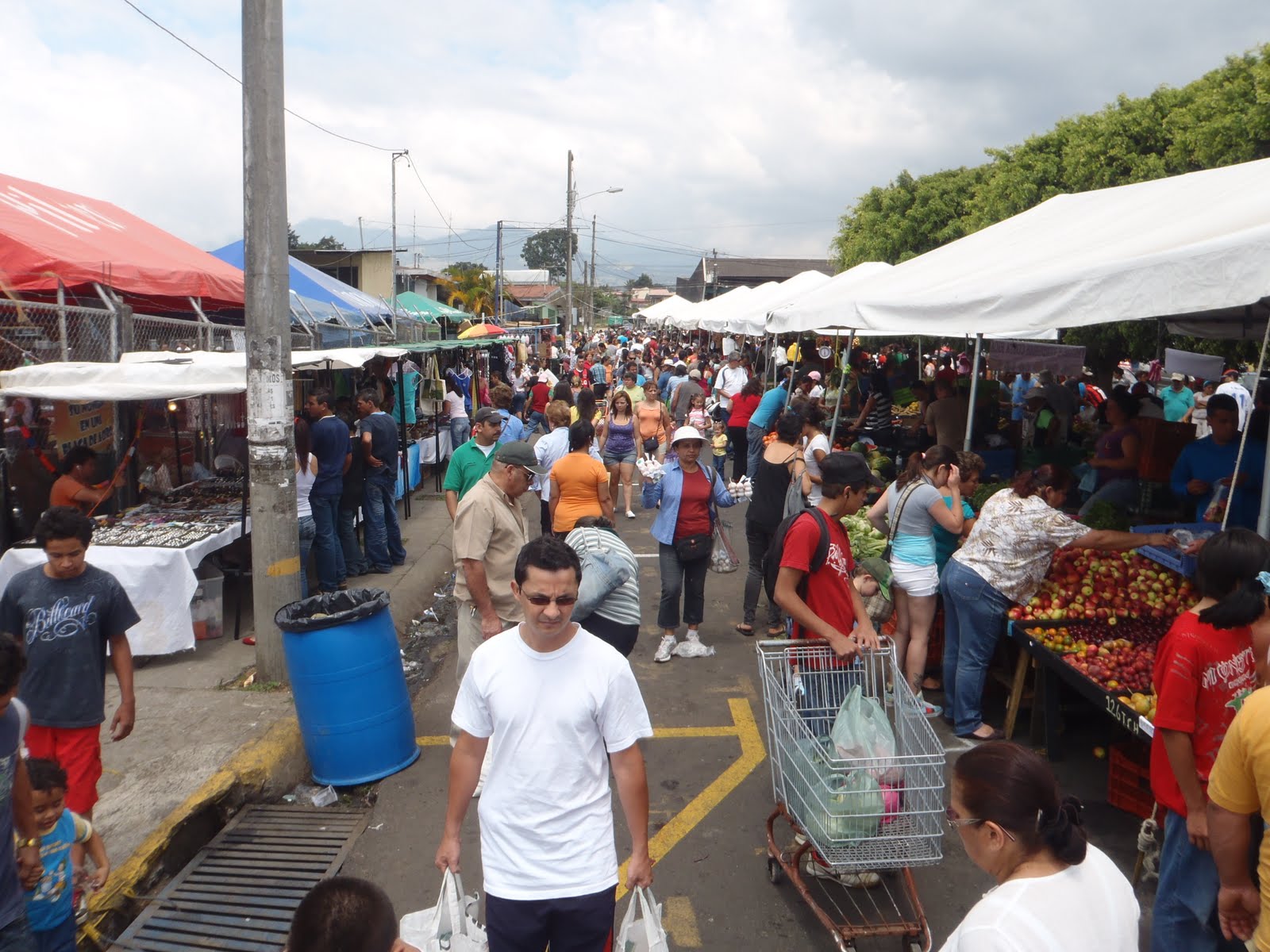 Passing time in my wife´s hometown of Coronado, Costa Rica has enabled me to enjoy the fruits of their wonderful farmer´s market. Every Sunday, agricultural producers from around the region reunite to promote their agricultural products to a hungry public. Two years ago a study revealed that Costa Rica is home to some of the healthiest, happiest people in the world. With the quality of fresh fruit and vegetables available at the farmer´s markets around the country it is easy to see why. Rather than buying canned or frozen vegetables most people their fruits and vegetables direct from a local producer. Meals here are typically accompanied by refreshing fruit drink called refresco. The Feria provides a wide variety of fruits ideal for these refreshing drinks. To the new visitor to the tropics the array of new fruits, vegetables, cooked and raw can be dizzying. The friendly sellers are always eager to answer questions and vocally encourage buyers proclaiming the quality of their products.
 Know Your Roots!!! Here you can see four different subterranean starchy root crops that are produced here. Standing out prominently are the purple skinned sweet pòtatoes (camotes) Ipomoea batatas seen throughout the country. In the left are two different types of Taro Colocasia esculenta seen here in Costa Rica. One, Ñampe, has a predominantly white flesh while the other, Tiquisque, is sprinkled a red or pink color. These edible corms have large elephant ear-like leaves and are members of the Araceae family. Finally, the roots on the right are Cassava (Yuca), Manihot esculenta.
 Eaten commonly throughout Costa Rica is this curious and versatile member of the Cucurbitaceae family, the Vegetable Pear (Chayote) Sechium edule. Baby chayotes like the ones shown in this picture can be steamed and eaten in their entirety. Larger chayotes range in color from deep to light green to white and are used in a variety of Costa Rican dishes. Also in this photo is the Chayote root, Raiz de chayote, which is highly prized and cooked as a vegetable. Chayote the only cucurbit I know of that you actually plant the entire squash as the plant sprouts out of the fruit´s one central seed. Less commonly seen in the markets but also enjoyed are Tacacos, Sechium tacaco a smaller, spikier wild relative of the chayote.
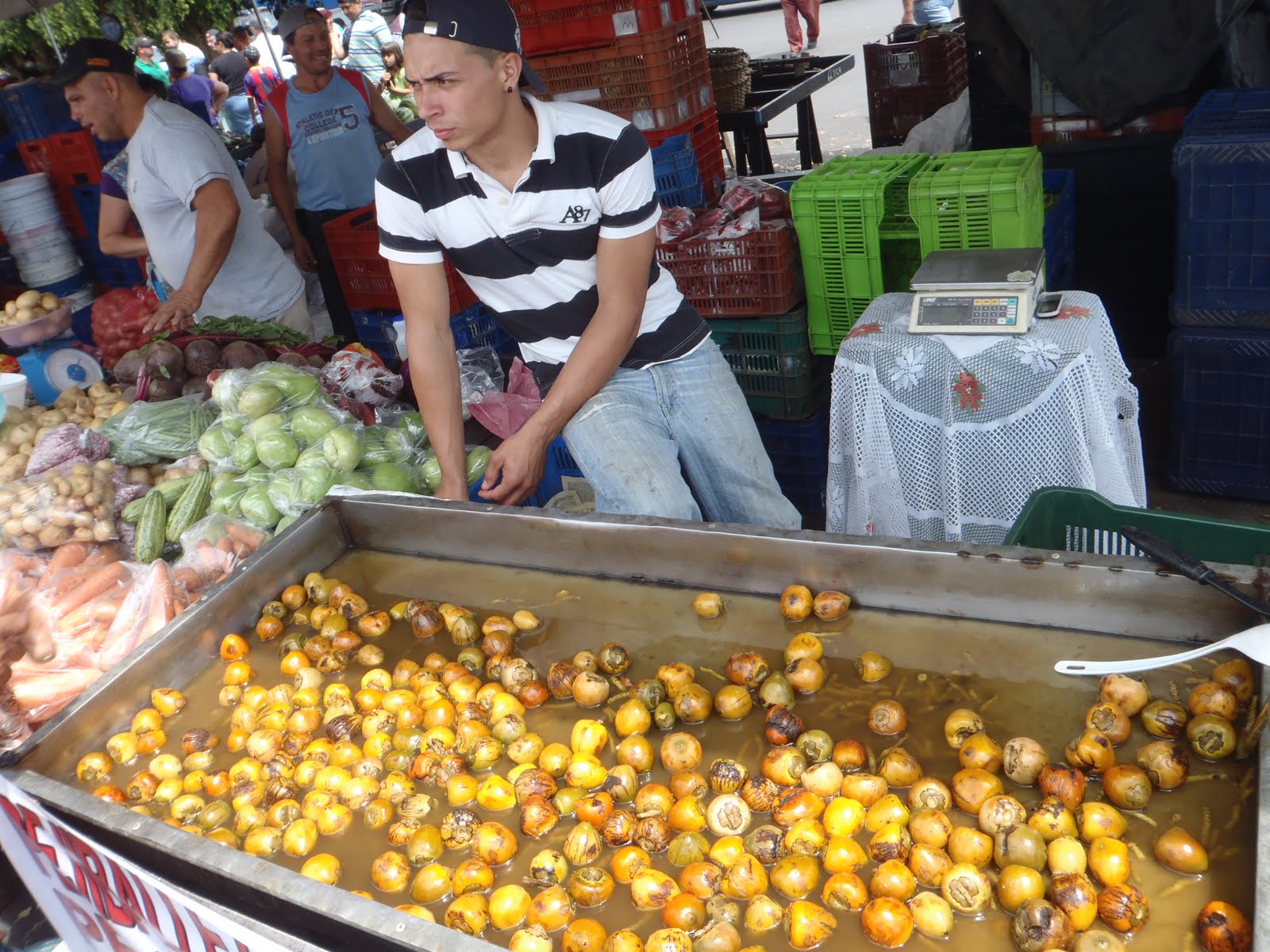
 Get to know a Costa Rican person and if you´re lucky they will invite you over in the afternoon for a cup of coffee and boiled pejibayes, peach palm, Bactris gasipaes, nearly always served with a dollop of mayonnaise. These nutritious fruits grow on a palm tree covered with long spines. Pejibaye trees can also be managed for production of heart of palm or palmito.
 Mangos Mangos Everywhere! Mango season seems to be lasting forever this year in Costa Rica. These mangos are of the large variety grown usually on grafted tres and known as Mangas here in Costa Rica. Its a great time to juice them freeze them, etc as they were selling 4 kilograms for 1,000 colones ($2!!!!)



 Posts


